TMTB Asia: Overnight Wrap
Asia TMT digests Warsh and Hormuz; AI video leads; Zhipu ARR prints; Semicon Taiwan opens — MiniMax and the China AI stack on the tape
Good morning from Asia. Asia TMT closed mixed under Hormuz headlines and hawkish Fed Chair Warsh — China tech and HSTECH recovered through the afternoon. Two AI-video catalysts still set the trade: generation that runs faster than consumption, and long-form AIGC on national TV, with MiniMax leading at +16%. Semicon Taiwan opens today.
| INDEX | 1D % |
|---|---|
| KOSPI | +0.46% |
| CSI300 | +0.35% |
| HSI | −0.07% |
| NKY | −0.14% |
| TAIEX | −0.44% |
| TECH | 1D % |
|---|---|
| STAR50 | +1.34% |
| HSTECH | +0.30% |
| KOSDAQ | −0.49% |
|1|Markets
| Semi | 1D % |
|---|---|
| Cambricon | +6.26% |
| Hygon | +3.43% |
| Gigadevice | +2.31% |
| SMIC A | +2.24% |
| Hua Hong | +1.99% |
| Will Semi | +1.55% |
| TSMC | −0.62% |
| UMC | −0.77% |
| MODELS | 1D % |
|---|---|
| MiniMax | +16.18% |
| Z.ai | +9.63% |
| OPTICAL | 1D % |
|---|---|
| Accelink | +3.62% |
| Fujikura | +3.07% |
| Sumitomo | +1.88% |
| Eoptolink | +0.72% |
| TFC | −0.22% |
| Yuanjie | −0.35% |
| Innolight | −0.75% |
| Bizlink | −3.98% |
| CSP | 1D % |
|---|---|
| Alibaba | +0.26% |
| Tencent | −0.48% |
| MEMORY | 1D % |
|---|---|
| Kioxia | +4.36% |
| Hynix | +1.27% |
| Samsung | +1.17% |
| Nanya | +0.56% |
| Winbond | +0.55% |
| CXMT | −1.01% |
| MLCC | 1D % |
|---|---|
| SEMCO | +2.60% |
| TDK | −1.09% |
| Murata | −2.78% |
| Yageo | −8.71% |
| SPE | 1D % |
|---|---|
| TEL | +0.37% |
| NAURA | +0.33% |
| Disco | −2.07% |
| Lasertec | −2.89% |
| Advantest | −4.48% |
| PCB | 1D % |
|---|---|
| Zhen Ding | +4.06% |
| GCE | +3.10% |
| Shennan | +1.84% |
| Isu Petasys | +1.06% |
| VGT | +0.64% |
Asia TMT — mixed; China tech led. Overnight US strike headlines in the Strait of Hormuz and hawkish Fed Chair Warsh set a cautious open, but the region’s tech tape held up better than the macro scare. China hardware and AI-content names led the afternoon turn; HSTECH recovered into the close even as the broad HSI slipped. Korea’s KOSPI ground higher on AI / institutional flows under MSCI noise. Japan’s Nikkei was nearly flat — semis soft, optical / AI firmer late. Taiwan was the clear TMT laggard: semis profit-taking, ABF the pain trade into the rebalance.
China — tech led the afternoon turn. The CSI300 closed +0.35% after a soft open on hawkish Fed Chair Warsh commentary. Tech hardware surged after lunch: Cambricon +6.26% and VeriSilicon +7.15%, with CCL names bid on continued industry price hikes. Media was the other tell — Mango Excellent Media (300413.SZ, Rmb16.98 +20.0%) hit limit-up as the fully AI-generated drama *后西游记* headed for its Monday premiere, extending the AI-content theme.
Hong Kong — HSTECH recovered; internet mixed. The HSI slipped −0.07% after an early ~1% selloff on Fed hawkishness and Hormuz headlines, but HSCEI and HSTECH eked out modest gains into the close, with Stock Connect still a stabilizing bid. NetEase was the soft spot on gaming-pipeline concerns; Meituan recovered on a JPM upgrade.
Korea — KOSPI +0.46%; AI / tech flows messy under MSCI. The index opened soft on hawkish Fed commentary, then ground higher into the close. Foreigners, local institutions and retail were net sellers in tech (−$300mn / −$668mn / −$166mn) on MSCI rebalancing, while “Other Corporates” bought +$1.2bn (+$1.1bn in tech), offsetting a chunk of the outflow. Turnover ran −18% versus the 20-day average.
Taiwan — TAIEX −0.44%; ABF the pain trade. The market opened soft but closed near the day’s high into the MSCI rebalance. Large caps were muted; SMID saw the volatility. ABF was hit hardest — Unimicron locked limit-down −10% on the labeling-probe overhang. Desk read: a quiet tape and healthy profit-taking after a strong SMID week, rather than a thesis break. Turnover was +13% DoD, with flows concentrated into the close.
Japan — NKY −0.14%; semis soft, optical / AI firmer late. An early semi-led selloff tracked the SOX and hawkish Fed commentary; the Nikkei recovered to nearly flat. AI names improved into the close, led by opticals, while semis continued to lag. Kioxia +4.4% reversed sharply higher into MSCI rebalancing flows. Higher-rate pressure weighed on SaaS and non-profitable tech.
|2|AI model
AI video is the trade again — two catalysts.
Catalyst 1 — generate faster than you can watch.
@levelsio called it a historical moment: fal’s Max, a post-trained MiniMax Hailuo / H3 variant, is ~50x faster than the prior loop — AI video can now be generated faster than users can consume it. Once that constraint flips, the product surface expands: live short-video streams, vote-driven plots and interactive narrative — formats that were awkward when each clip took minutes to render.
Three reads from the same print: (1) real-time AI video stops being a science demo and becomes a product category; (2) Max being post-trained on MiniMax H3 is a clean vote for the open-source / open-weights path in video; (3) aesthetic models are not fungible the way coding agents are — less need for a pure price war, more room for retention and network effects.

You can now generate AI video faster than you can watch it
Before it'd take let's say 2-5 minutes to generate 15 seconds of video
@fal made a post-trained Minimax H3 variant called Max which is 50x faster than the
Catalyst 2 — AIGC long-form on national TV.
Mango TV’s *后西游记* is the first fully AI-made long drama to land on a traditional China media channel with national reach — Hunan TV prime time, not just a short-video feed. S1 is ~30 episodes × ~40 minutes, produced / reviewed / aired in parallel and built on Seedance 2.0/2.5. Investors already know AI clips well; what is new is long-form AIGC clearing a state-level broadcast gate.

A-share gaming and AI-video names reportedly blew up on the tape.
China’s first fully AI-produced long drama, Hou Xiyouji (Post–Journey to the West), launches on Mango TV today and lands in Hunan TV prime time.
Season 1: 30 episodes × ~40 minutes each — produced, reviewed, and aired in parallel.
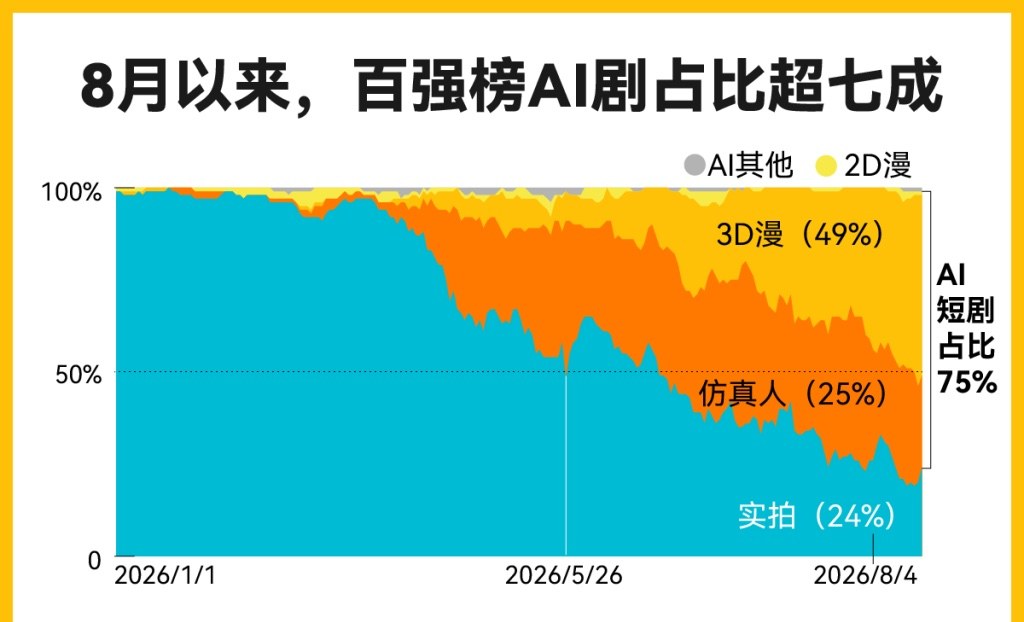
Coding stayed fungible: if it runs, it works, and price competition follows. Video is the opposite. Taste is subjective, stickiness is high, and China SOTA is basically global SOTA. That is a better setup for listed names than another race to the bottom in inference pricing. MiniMax (0100.HK, HK$349 +16.2%) ripped on the day and spilled into the broader China/HK AI tape.
MiniMax said on its March earnings call that the stack would move short → mid/long → real-time. The tape is compressing that sequence: short-drama domination already, long-form on Mango now, and real-time generation speed is emerging.
Outside coding, investors still need a second “worked” scenario. China’s AI video stack — model, short-drama factory, and now long-form broadcast — is running ahead of most other markets.
Today the whole chain is bid, from the distribution-channel layer and content layer to the AI model layer: Mango Excellent Media / 芒果超媒 (300413.SZ, Rmb16.98 +20.0%), China Literature / 阅文 (0772.HK, HK$21.48 +7.0%), other onshore media names, and MiniMax (0100.HK, HK$349 +16.2%).
Investor feedback so far: if content becomes infinite, channels and models matter more than another IP factory. That said, this is still the broad risk-on / theme-chase stage, not stock-picking yet.
Open weights keep taking share on Vercel.
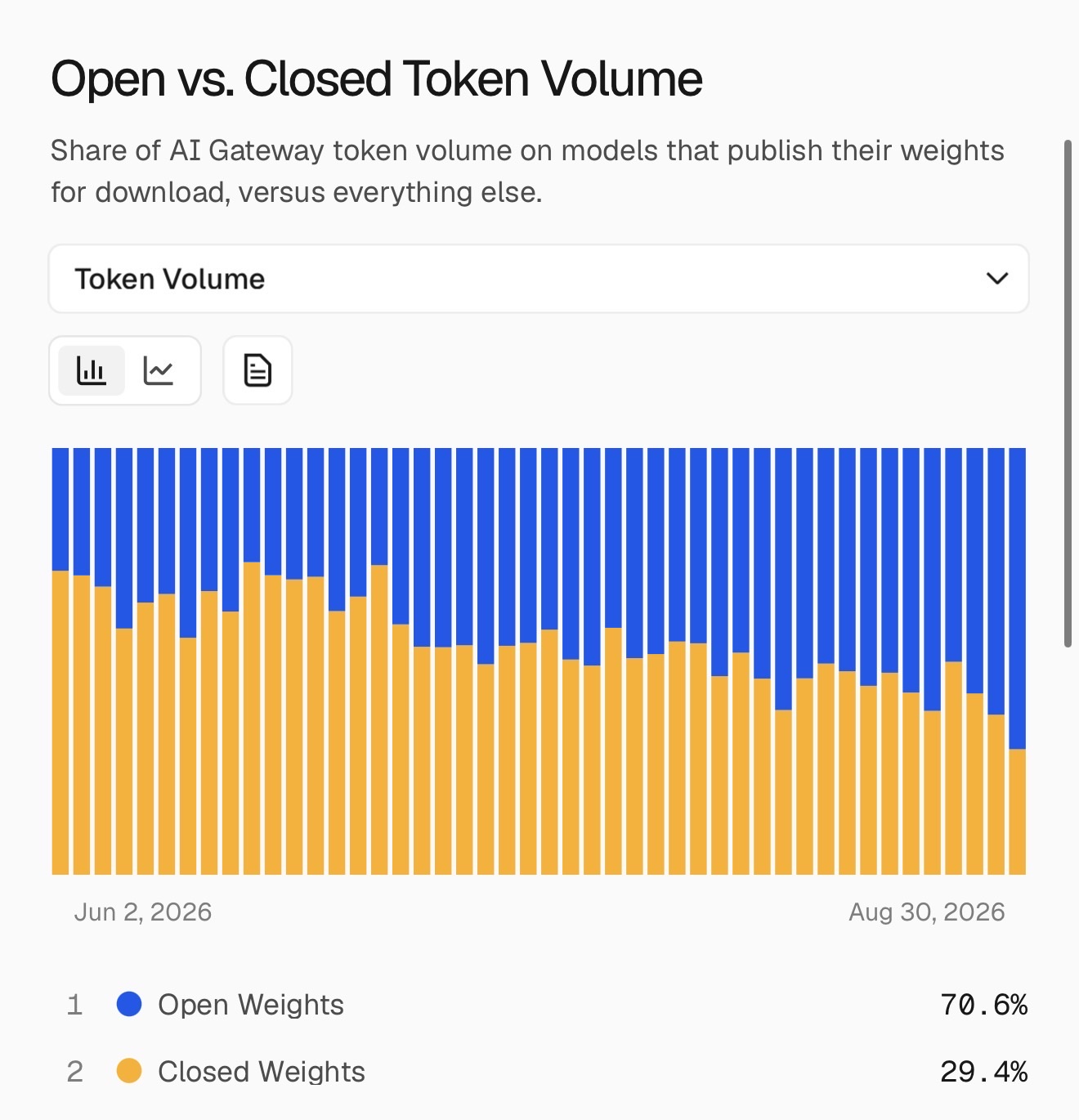
Through Aug 30, Vercel’s AI Gateway token volume has flipped hard toward open-weight models — about 70.6% open vs 29.4% closed, up from a clear closed-weight majority in early June.
Tencent WorkBuddy / Hy4 Preview hit a capacity wall. Official chatter says Hy4 Preview demand blew through the queue — emergency cluster expansion is underway.

After Hy4 Preview launched, the task queue blew up. Tencent has already expanded capacity, but peak hours may still wait.
Main issues:
• High-end compute is limited + peak concurrency is bunched, so some windows still hitch
• Hy4 Preview daily free quota is capped (free through Sep 10, 23:59)
• It’s a pure language model — image/video auto-routes to other models and burns credits
Official response + user workarounds:
• Emergency expansion of the Hy4 Preview inference cluster, with ongoing dynamic allocation
• Switch to Hy3 now if needed (Hy3 free window extended through Sep 30, 23:59)
• Off-peak / evening use is more stable for non-urgent jobs
• When the daily limit hits, the page shows when quota resets
• Multimodal jobs auto-switch models and don’t eat the Hy4 free quota
The new model is strong — compute just hasn’t caught the heat yet. Use Hy3 as overflow until the Hy4 expansion fully lands.

Zhipu just reported US$1.6bn ARR (end-August).
ARR: March US$250mn → early July US$1.0bn → end-August US$1.6bn. YE ARR bogey ≥US$2.0bn — only ≥25% from the August print; YE number to be disclosed.
Some quick numbers — Zhipu 1H26: revenue miss, API beat
1H26 revenue Rmb954mn, −24% vs consensus (Rmb1,258mn), even as growth stayed extreme (+400% YoY). Mix is the story: open platform / API Rmb825mn, +4% vs consensus, now 87% of sales (vs ~63% expected); localized deployment Rmb129mn, −69% vs consensus, and the main drag. Gross margin 26.4%, −9.5pp vs consensus (35.9%). API GPM roughly in line at 24.6%; localized GPM 37.9%, −10.8pp vs consensus. Opex mix was uneven — sales and admin well below consensus, R&D Rmb2.13bn +8% above consensus. Adjusted net loss Rmb1.96bn, wider than the Rmb1.73bn consensus.
|3|AI hardware
Iluvatar CoreX (9903.HK, HK$388.20 −2.2%): in-line sales, messy mix
Revenue was broadly in line and earnings beat on a non-operating gain, but the underlying mix was less clean. Gross margin missed on pre-committed, below-cost memory / component sales that JPM treats as a largely one-off 2026 headwind.
Investors acknowledge Iluvatar’s progress into key local accounts like ByteDance, but remain skeptical about order durability — local CSPs still look content to sample broadly across vendors, and that is not enough to conclude that “demand will never be an issue.” Over the weekend, MetaX (688802.SS, Rmb691.20 +2.4%) reported 1H revenue up ~45% YoY to Rmb1.2bn, with a better bottom line and management citing significantly higher shipments. With more aggressive 2027 expectations seemingly embedded across China GPU makers, the supply-constraint debate has broadened from foundry yields / capacity to HBM availability.
Victory Giant / 胜宏 (2476.HK, HK$220.20, 0.0%): AI projects ramp 2H26; order visibility into FY27 — JPM OW, PT HK$500
JPM expects VGT earnings growth to re-accelerate from 3Q, supported primarily by mass production for the Vera Rubin platform and ASIC projects. The stronger order book has prompted the company to accelerate capacity expansion and bring forward its Rmb100bn output-value target to end-FY27. While that could weigh on margins during the ramp, JPM thinks capacity readiness should help defend wallet share while improving mix and margins. Shares initially fell ~13% on weaker 2Q GMs — upfront labor and depreciation costs ahead of new project ramps, not a demand miss.
Semicon Taiwan starts today. Expect more coverage from friends on the floor as the week unfolds. The six major themes on the badge: advanced packaging (CoWoS, FOPLP, chiplets); silicon photonics and CPO; quantum; smart manufacturing and robotics; SiC / GaN; and physical AI, drones and robotic vision. Taiwan runs as an integrated platform — design, manufacturing, packaging, photonics, servers and AI applications under one roof.

This would enable on-interposer optics and optical I/O for chip-to-chip interconnect one tray.

|4|Other
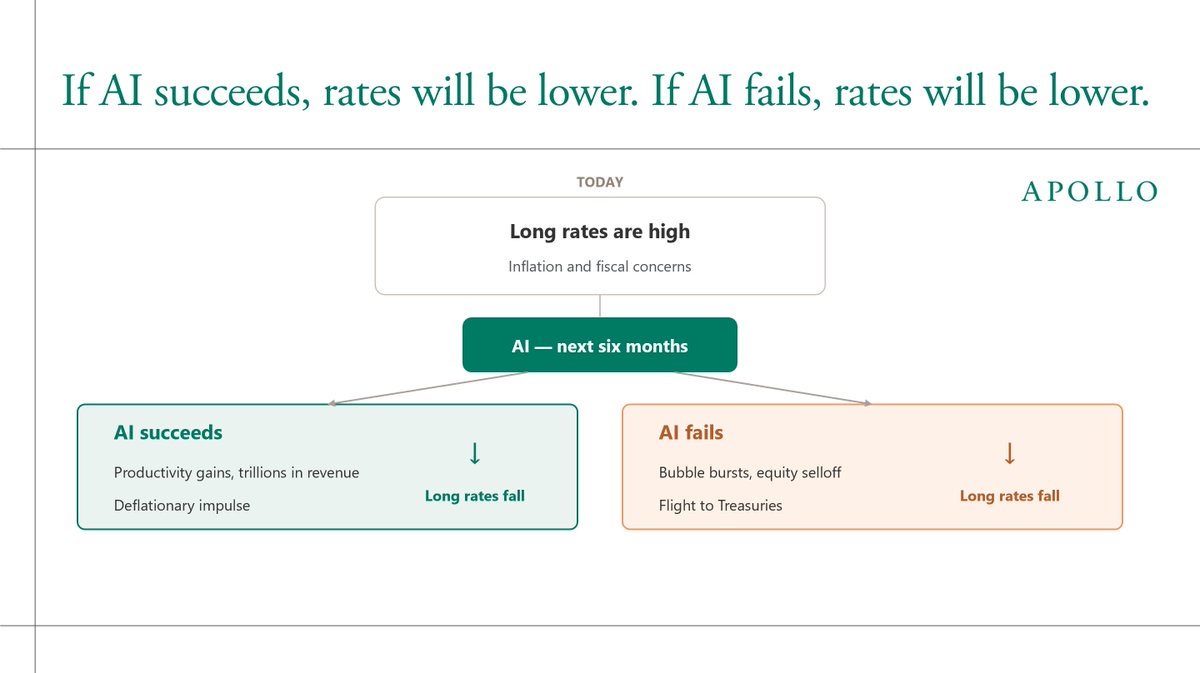
Apollo: think six months ahead — AI’s rate path is strangely one-sided.
A neat framing from Apollo: long rates are high today on inflation and fiscal worries. Look six months out and both AI outcomes point the same way. If AI succeeds and tech companies generate trillions in revenue, the productivity impulse is massively deflationary and pushes rates lower. If AI does not work out, the bubble bursts, the Nasdaq is down ~50%, investors rotate out of equities into Treasuries — and long rates fall dramatically. Same destination, different road.
|5|Sell-side
Silergy (6415.TW, NT$412.5 −9.9%): Datacenter mix is ramping faster than expected — JPM OW, PT NT$700
JPM flags a soft 2Q gross margin on higher foundry and OSAT costs, but management was constructive on revenue growth and margin recovery. The more important read is datacenter: V-core and other motherboard products qualified faster than the market expected with general-server CPU customers on AMD platforms and AI ASIC customers using TPU power-management ICs. Total datacenter contribution—including optical through Innolight, storage and related products—could reach 15–20% of FY26 sales from ~7% in FY25 and become more material in FY27. Management expects solid 2H26 demand, led by new Gen4 orders in higher-end datacenter and auto plus some share gains at major consumer accounts, easing concern about downstream inventory overbuild after rush orders. As 2H26 ASP increases feed through, JPM expects mix-led gross-margin improvement to offset inventory write-off noise.
Unimicron (3037.TW, NT$999 −10.0%): JPM sees limited scope from the PCB “Made in Taiwan” labeling probe
JPM notes that Taoyuan prosecutors are investigating Unimicron for allegedly relabeling China-made PCBs as “Made in Taiwan” after import. PCBs, including HDI, represent ~29% of FY26 revenue and ~14% of operating profit. The allegation centers on whether Unimicron skipped the proper process-change notification, or PCN, when moving fabrication, equipment or materials to China. PCBs and HDIs for major AI GPU servers—~50% of FY26 PCB/HDI revenue—are already certified in both Taiwan and China, making a procedural PCN breach less likely for that business. JPM expects tighter PCN diligence from here and does not see the issue extending to substrates, where procedures are already stringent.
Foundries: JPM sees leading-edge capacity tight through FY28 as mature-node pricing firms
TSMC (2330.TW, NT$2405 −0.6%) raised FY26 revenue guidance to 40%+ y/y in US-dollar terms, above the mid-to-high 30s expectation, and lifted capex to US$60–64bn; management now sees AI demand visibility stretching into FY29–30. The 2Q pricing narrative at mature foundries also improved, with results largely in line to slightly above expectations as hikes took hold: UMC (2303.TW, NT$129 −0.8%) expects pricing to stay firm, VIS said FY27 pricing could be more robust, and PSMC (6770.TW, NT$73 +4.3%) posted strong revenue growth on a surge in memory ASPs. JPM expects TSMC’s leading-edge supply-demand balance to remain tight through FY28 and selective pricing in power management, analog and MCUs to keep improving, though faster capex-driven depreciation and weak consumer-electronics demand may still cap longer-term margin recovery at names such as UMC.
Global physical AI and humanoids: GS lifts the unit path, favoring semis and virtual PLCs as picks-and-shovels
Goldman raises the global humanoid forecast to ~890k units by 2030 and ~6.5mn by 2035, implying a ~US$138bn market. The upgrade reflects faster physical-AI progress, open-source tooling and rising funding, with logistics and warehouse operations likely to be the first real adopters. GS’s investable read is less about any single robot OEM than the supply chain: humanoid scale should become a structural demand driver for semiconductors and accelerate the shift to software-defined and virtual PLCs, spreading the opportunity across chips, software and industrial automation. The note also launches “Executive Perspectives” powered by Goldman, with its first survey focused on physical AI.

Memory is expected to be up to 40% of semiconductor dollar content for humanoid robots (excluding GPU/CPUs).
Goldman Sachs: Although content can vary, we assume an average system (DRAM) memory of about 128GB for a single humanoid unit, with a non-volatile (NAND) memory of about 1TB.
Based on an assumed system memory of 128GB and a non-volatile memory capacity of approximately 1TB, we see a SAM range of between $250-$350 for DRAM and $350-$450 for NAND, for a total memory SAM of between $600-$800 or more per unit.
Given the significant edge compute workloads of humanoid units, we expect that at least a portion of each system’s memory will rely on HBM, which is primarily supplied by Micron, Samsung, and SK Hynix where competition from Chinese memory makers (such as CXMT) may be limited in the near-term.
Though whether humanoid manufacturers will decide to source HBM and traditional DRAM from separate vendors remains to be seen.
Prices for DRAM and NAND memory can vary, though we utilize the rough market price for memory at the time of writing in our assumptions given that many LTAs have been struck at these levels.
$DRAM

Weichai Power (2338.HK, HK$31.84 −2.8% / 000338.SZ, Rmb27.17 −1.7%): AIDC power-generation guidance moves higher — GS Buy
Goldman stays Buy after a better-than-expected 2Q, with management upgrading AIDC power-generation guidance toward a potential tripling of segment earnings by 2027. GS raises 2026–28 EPS estimates by 1–13%, putting them 6–22% above consensus, on higher diesel large-engine and gas-genset shipment forecasts. It sees AIDC power generation exceeding Rmb11bn and contributing ~half of total net profit by 2027, while continuing to view the stock as undervalued. The 12-month targets remain HK$55 for the H shares and Rmb48 for the A shares.
Tencent (0700.HK, HK$453 −0.5%): Hunyuan 4 preview shows a coding and agentic step-up — GS Buy, TP HK$670
Goldman keeps Buy and a HK$670 target after the earlier-than-expected Hunyuan 4 preview. The model scales to ~770bn total parameters, delivering clear gains in coding and agentic performance while retaining a cost-to-performance edge. GS likes the closed loop: Tencent can ship previews through its ecosystem apps, gather real-user data and compound differentiation in productivity workflows. Near-term capex intensity may still weigh on the tape, while continued model launches and gradual adoption of AI-native apps are the share-price drivers.
CXMT (688825.SS, Rmb58.01 −1.0%): 2Q26 AI DRAM beats as local capacity expands — GS Buy, TP Rmb129
Goldman stays Buy with a Rmb129 target after a strong 2Q beat: revenue of Rmb99.5bn and net income were 52% and 75% above GS estimates, respectively, on robust AI DRAM demand, elevated pricing and customer supply-chain diversification. GS raises 2026E net income by 14% and keeps CXMT as a core beneficiary of local DRAM and HBM demand, supported by capacity expansion and faster LPDDR6 mass production.
Meituan (3690.HK, HK$78.90 +1.8%): 2Q profit beats as GTV leadership takes priority — GS Buy, TP HK$123
Goldman updates 2026–28E adjusted net profit to Rmb1.6bn / Rmb23.2bn / Rmb42.7bn and keeps Buy with a HK$123 target after a 2Q profit beat. GS expects 3Q profit per order to fall sequentially on seasonality and a deliberate push for GTV share during peak season, leaving near-term unit economics uneven, but holds its medium-term food-delivery EBIT per order at Rmb1.1 given Meituan’s leadership in higher-AOV segments. The local-services franchise and better-than-expected margins in in-store, hotel and travel underpin the Buy.
Montage (688008.SS, Rmb204.95 −3.8%): DDR5/6 mix improves, with AI interconnect next — GS Buy
Goldman cuts 12-month targets to Rmb380 for the A shares and HK$572 for the H shares after in-line 2Q net income of Rmb1.15bn, while a 61.8% gross margin missed on mix. Management still sees migration to next-generation DDR5 and DDR6 interface ICs as the growth engine, with DDR5 Gen3/Gen4 already exceeding 50% of 1H26 RCD shipments. GS remains constructive on the AI interconnect portfolio and a more meaningful MRCD/MDB ramp from 2027, but trims 2026–32 earnings by ~2% for a slower CKD ramp and lower gross-margin assumptions under cost pressure.
InnoScience (2577.HK, HK$45.70 −1.3%): GaN mix is shifting toward AI datacenter and auto — GS Buy, TP HK$114
Goldman stays Buy with a HK$114 target after 1H26 revenue rose 51% y/y to Rmb834mn and gross margin reached 11.6%, with both missing GS estimates on weak consumer electronics. Discrete growth was muted, but GaN shipments into AI datacenters and automotive surged 183% and 103% y/y, respectively, with customized design-ins at 20+ CSP clients. GS widens its 2026 net-loss estimate to Rmb448mn from Rmb355mn on lower discrete and IC revenue; the longer-term case remains capacity expansion and a mix shift into higher-value GaN.
Range Intelligent (300442.SZ, Rmb66.22 +4.9%): 2Q EBITDA beats on disciplined AIDC spending — GS Buy, TP Rmb117
Goldman reiterates Buy with a Rmb117 target after a mixed 2Q: adjusted EBITDA rose 84% y/y, a 3% beat, while revenue growth of 47% slightly missed. Better cash gross margins and opex control drove the profit beat, even as elevated GPU costs prompted Range to defer incremental server purchases and lean on in-house technology. Management still treats AI datacenters as the core growth engine, prioritizing long-term contracted orders over thinner, higher-margin spot deals. GS remains positive on capacity reserves, full-stack capability and overseas expansion in APAC.
PCB and CCL: Global price hikes keep rolling through — Meritz constructive on Doosan (000150.KS, ₩1,263,000 +2.0%)
Meritz flags another wave of global CCL increases: Kingboard is lifting FR-4 by ~10% and PP by 10–20%; Nan Ya Plastics is raising CCL and prepreg by 20–25%; and Panasonic Industry is increasing general CCL and semiconductor-packaging materials by 30%, and low-loss materials and FCCL by 15%. The squeeze starts with raw materials—glass fabric, including E-glass, and high-spec copper foil remain short, logistics costs are higher and AI-server CCL specifications are becoming more demanding. Domestic board makers face another round of ASP pass-through after 1H across FC-BGA, memory-packaging substrates, module PCBs and MLB. For Doosan, Meritz sees greater scope for further CCL hikes and margin upside from its memory-packaging CCL share and high-end mix in LPDDR6, GDDR7 and SOCAMM, with 4Q brownfield capacity coming online.
|6|News
Samsung Electronics (005930.KS, ₩260,000 +1.2%) / SK hynix (000660.KS, ₩1,674,000 +1.3%): LTAs lock the wafer plan as Hynix looks for more fabs
Sedaily reports the AI memory squeeze has become structural: Samsung Memory has allocated ~70% of production capacity through 2031 to LTAs, mainly with Nvidia, Microsoft and Google, while SK hynix is exploring further capacity in Yongin and Honam and a potential Japan JV fab with a Japanese partner. Industry chatter points to deeper Kioxia cooperation. With spot HBM still at ~4–5x LTA pricing, contracted volume remains scarce even for hyperscalers that have already signed. LINK
SK hynix (000660.KS, ₩1,674,000 +1.3%): HBM4E base dies — TSMC-only is getting expensive
Herald reports SK hynix is exploring Intel Foundry for HBM4E (7th-gen) base dies after using in-house base dies through HBM3E and moving HBM4 to TSMC’s ~12nm logic. TSMC’s base die is said to cost 3–4x Hynix’s own 1b core die on HBM4, and LTA-heavy pricing makes that foundry inflation hard to pass through; a second vendor would offer cost leverage and a hedge as custom HBM designs proliferate. Hynix denied the specific HBM4E-to-Intel review, but the industry still sees multi-vendor base dies—and eventual EMIB packaging optionality—as the strategic direction. LINK

To support this, 20k WPM of N3 capacity is needed, which is nearly 10% of the total N3 capacity in 2027 (a lot)
Diversifying to Intel makes a lot of sense
Asustek (2357.TW, NT$999 +3.5%) / MSI (2377.TW, NT$155 +6.9%): RTX Spark AI PCs sell out on pre-order
Economic Daily reports the first batches of AI PCs built around Nvidia’s RTX Spark processors from Asustek and MSI sold out completely in pre-order, prompting both to ask Nvidia for more chips built on TSMC 3nm. LINK
PC DRAM: TrendForce lifts Q3 price-hike forecast to 18–23% QoQ
TrendForce raised its Q3 PC DRAM price-increase forecast in August to 18–23% QoQ from its July call of 15–20%.

As of August, it now expects prices to rise 18–23% QoQ, up from its July forecast of 15–20%.
|7|Coming catalyst
- Aug 26 — Nvidia earnings
- Sep 2–4 — Taiwan Semicon
- Oct 12–15 — OCP 2026